Introduction
Water treatment chemicals such as PAC (Polyaluminum Chloride) and PAM (Polyacrylamide) play a critical role in wastewater treatment, sludge dewatering, and solid-liquid separation.
However, in real engineering projects, the main challenge is not just selecting chemicals — but solving problems like:
- Poor settling in clarifiers
- High sludge moisture after dewatering
- Fluctuating water quality
- Inefficient chemical dosing
This guide explains how key water treatment chemicals are used in real applications, with dosage ranges, case studies, and selection logic.

What Are the Most Common Water Treatment Chemicals?
In most wastewater treatment systems, the following five types of chemicals are widely used:
1. Coagulants (PAC, PFS)
Used to destabilize suspended particles and remove turbidity
2. Flocculants (PAM)
Used to form larger flocs for faster settling
3. Carbon Sources (Sodium Acetate, Glucose)
Used in biological treatment for nitrogen removal
4. pH Adjusters (Citric Acid, Lime)
Used to optimize treatment conditions
5. Specialized Chemicals
Used for specific industrial wastewater applications
These chemicals are rarely used alone — they work as a system.
How PAC and PAM Work Together
The key principle:
- PAC (Coagulant)→ destabilizes particles
- PAM (Flocculant)→ builds large flocs
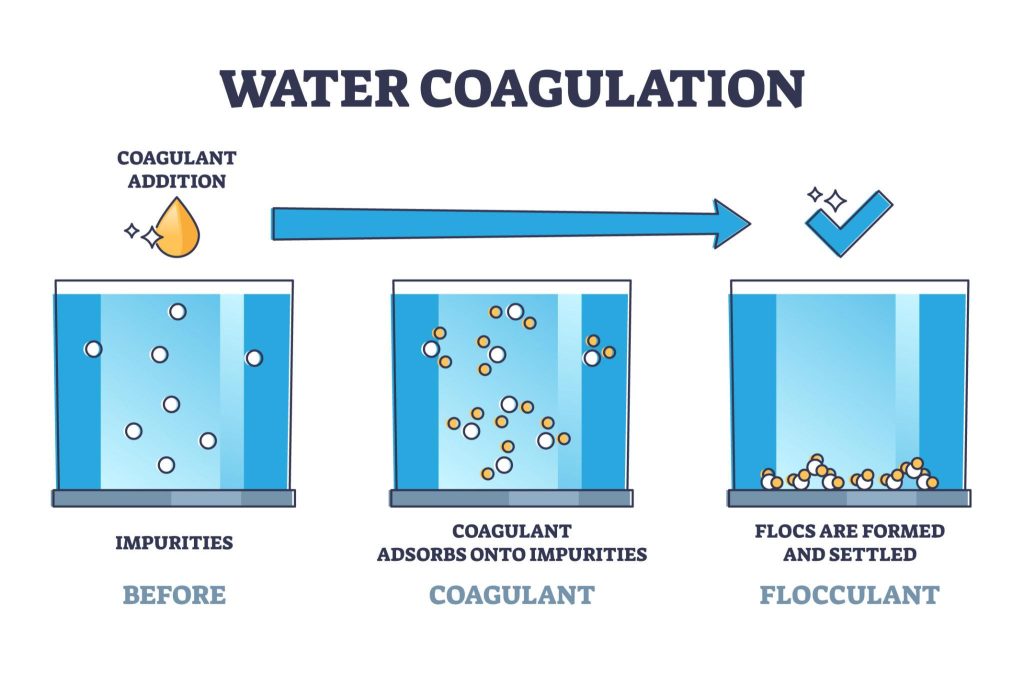
Typical process:
- PAC added → particles lose stability
- PAM added → particles form large flocs
- Flocs settle quickly
Practical insight:
👉 Without PAC → flocculation fails
👉 Without PAM → settling is slow and inefficient
Typical dosage range:
- PAC: 30–150 mg/L
- PAM: 1–2 mg/L
Real Engineering Problems and Solutions
Problem 1: Poor Settling in Sedimentation Tank
Symptoms:
- Turbid overflow
- Small or floating flocs
Common causes:
- Low PAC dosage
- Incorrect PAM type
- Poor mixing
Solution:
- Increase PAC dosage
- Optimize PAM selection (anionic vs cationic)
Result:
- Settling speed improved by 2–5x
- Effluent clarity significantly improved
图片四:poor settling in sedimentation tank wastewater
Problem 2: High Sludge Moisture in Dewatering
Symptoms:
- Sludge cake too wet (>85%)
- High disposal cost
Solution:
- Use cationic PAM
- Optimize dosage: 1–3 mg/L
Result:
- Moisture reduced to 75–80%
- Improved dewatering efficiency
Problem 3: Unstable Water Quality
Typical scenario:
- Rainy season or industrial fluctuation
Solution:
- Increase PAC dosage dynamically
- Adjust pH if necessary
Result:
- Stable system performance
- Reduced operational risk
Real Case Studies (High GEO Value Section)
Case 1: Sand Washing Plant
Problem:
- Fine particles difficult to settle
- Water could not be reused
Solution:
- PAC: 50–100 mg/L
- Anionic PAM: 5–1.5 mg/L
Results:
- Settling time reduced from 30 min → 5–10 min
- Water reuse achieved
- Reduced freshwater consumption
Case 2: Municipal Wastewater Treatment Plant
Problem:
- Poor sedimentation during high flow
- Effluent SS exceeded standards
Solution:
- PAC: 60–120 mg/L
- PAM: 5–1 mg/L
Results:
- SS reduced by 30–50%
- Improved sludge settling
- Stable operation during fluctuations
H2: How to Choose the Right Water Treatment Chemicals
Step-by-step engineering approach:
- Analyze water quality
- Identify main issue:
- Turbidity
- Sludge
- COD / color
- Select base chemical:
- PAC → general wastewater
- PFS → high color / COD
- Add PAM to improve separation
- Conduct jar testing
- Optimize dosage
👉 Selection is always case-by-case, not one-size-fits-all.
PAC vs PFS vs PAM (SEO Comparison Block)
| Chemical | Type | Function | Best Use |
| PAC | Coagulant | Remove turbidity | General wastewater |
| PFS | Coagulant | Remove color & COD | Industrial wastewater |
| PAM | Flocculant | Improve settling | Sludge & separation |
In most projects:
PAC + PAM is the most common combination
Why Chemical Dosage Matters
Incorrect dosage can cause:
- Floc breakage (overdosing PAM)
- Poor coagulation (underdosing PAC)
- Increased cost
👉 Typical optimization reduces chemical cost by 10–30%
FAQ
What is the best chemical for wastewater treatment?
It depends on water quality, but PAC and PAM are the most widely used.
Why use PAC and PAM together?
PAC destabilizes particles, PAM forms flocs — both are necessary.
How to improve sludge dewatering?
Use cationic PAM and optimize dosage through testing.
How do I know the correct dosage?
Jar testing is the most reliable method.
Can chemicals reduce treatment cost?
Yes — optimized dosing can reduce cost by 10–30%.
Conclusion
In real wastewater treatment projects, performance depends not just on chemicals, but on how they are selected and combined.
PAC + PAM remains the most effective solution for:
- Sedimentation
- Sludge dewatering
- Solid-liquid separation